Grades 5–6
 3 Sessions, 2 Hours Each
 PersuasiveLessons
In this lesson students will learn how to provide examples and evidence to differentiate between persuasive writing and opinion writing to produce a good persuasive essay.

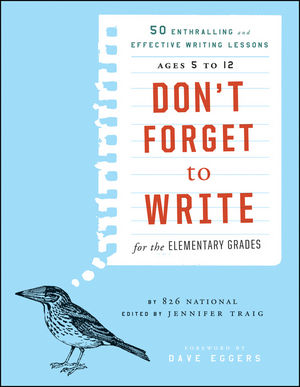
Don't Forget to Write for the Elementary Grades offers 50 creative writing lesson plans from the imaginative and highly acclaimed 826 National writing labs. Created as a resource to reach all students (even those most resistant to creative writing), the lessons range from goofy fun (like "The Other Toy Story: Make Your Toys Come to Life") to practical, from sports to science, music to mysteries. These lessons are written by experts, and favorite novelists, actors, and other celebrities pitched in too. Lessons are linked to the Common Core State Standards.
by Jessica Barbaria, 826NYC
In this lesson, students dive into the many forms bullying can take, create scripts and role-play bullying scenarios, and reflect on their own experiences with bullying.
by Emily Clader & Daniel Reck, 826michigan
Students will create infinite poems using fractals, imagine life on a doughnut, and speculate about a universe where time goes crazy. Along the way, they'll explore cool, new math facts and concepts.
by Mindy Misener, 826michigan
Students learn how poetry can “break the rules” then practice breaking the “rules” in their own poems by challenging the expectations, assumptions, and principles their work set up.
by Alana Herron, 826 Digital Educator Leader
Students will craft an argument about a controversial topic they hold a personal connection to and record their argument to persuade their audience.
by Naomi Solomon, 826NYC
In this lesson, students will learn about different types of rhymes, identify rhymes in lyrics and generate rhymes to use in their own lyrics.
by Jory John, 826 Valencia
Students will explore the essentials of an effective “how-to” piece, while considering their own areas of interest and expertise to share with their peers and the world at large.
By Jillian Wasick, 826 Valencia
In this lesson, students write vegetable-inspired superhero stories.
by 826 National and Cartoon Network
This lesson encourages students to consider and write about the myriad ways to include someone, stop bullying before it starts, and make a difference.
by Bryan Wilson, Educator Leader, The Bureau of Fearless Ideas
What do you get when you mix foraging with metaphors? Metaphoraging, of course! In this interactive lesson, students will forage their learning space for metaphors.
by Laura Lisabeth, Ph.D, 826NYC
In this lesson, students experiment with the multimodal composition of Instagram and use this social media platform to promote a social justice issue.
by Jayne Kennedy, 826LA
Gather students around the metaphorical campfire to craft a brochure for a Nature Preserve on another planet, complete with crazy critters, plant life, unique geological formations, and park history
by Robert Paterno, 826LA
A mock crime scene kick-starts this lesson, getting students to hone their inferencing skills and serving as inspiration for crime stories.
by Ashley Smith, 826 Valencia
Students find gratitude all around as they thank ordinary objects in their lives in the form of an ode.
by Louise McCune, 826 Valencia
Working as budding archaeologists, students use artifacts as inspiration for several short writing pieces.
Inspired by Angela Iton and Precediha Dangerfield, 826 Valencia
In this lesson, students will use mentor texts to hone their revision skills before turning to their own poetry drafts.
by Ashley Smith, 826 Valencia
In this lesson, students will explore different holidays people celebrate around the world and then create a new holiday of their own.
by Neil Gordon, 826LA
Using precise, clear instructions, each student will create a treasure hunt document that provides clues for finding a treasure hidden in a location of their choosing.
by Nathalie Lagerfeld & Jill Carey, 826CHI
Borrowing inspiration from out-of-this-world illustrations, students will create an amazing sci-fi story with a fantastical setting, realistic characters, and page-turning plot.
by AT Bianchi & Kati Shanks, 826michigan
In this lesson, students imagine a fictional sport for fantastic beings, create a statistic for that sport, and write a newspaper article about the championship game.
by Kyley Pulphus, 826 New Orleans
In this workshop, students will create a pourquoi tale, or origin story, of how a local delicacy came to be.
by Klariza Alvaran, 826CHI
In this lesson, students explore the graphic novel genre with a focus on plot and character development, scripting dialogue, and visual composition.
by 826 National, in partnership with Paramount Pictures
Imaginary friends come in all shapes and sizes! Inspired by the new Paramount Pictures movie, IF, students will create their own imaginary friend to take with them on their next adventure.
by Ola Faleti, 826CHI, with an introduction by Amanda Gorman, Inaugural Youth Poet Laureate of the U.S.
The pen is mightier than the sword. In this lesson, students learn there's no better evidence of this than the poetry behind social movements.
by Allison Peters, 826michigan
Discover what’s possible through writing. In this lesson, students will write a thrilling new story about their future selves inspired by their curiosity and imagination.
by Mariama J. Lockington & Peter Calhoun Hall, 826NYC
In this superlesson, students isolate DNA, design planes, build lairs, and engineer safe transport to help a hero save the day. Students will also take technical notes and explore new forms of poetry.
by Rebecca Darugar, 826NYC
Students will work in a collaborative, constructive setting to create a vision for your classroom as a safe space for students and teachers.
by Rebecca Darugar, Liz Levine, and Brancey Mora, 826NYC and 826 National
Invite students to write about their personal experiences with social media and online platforms with this lesson from 826NYC.
by Kathy Seipp, 826 Digital Educator Leader
In this lesson, students will illustrate the literal and figurative meaning of idioms and write using idioms.
by Paris Hyun, 826LA
Students play the role of benevolent inventor. They identify and think critically about real world problems, and create an ingredients list and usage instructions for an elixir that fixes the problem.
by Meredith Goldberg-Morse, 826LA
In this lesson, students write about a cause that they are passionate about, imagine how they can create change, and come up with slogans to convince other people to take action.
by Cristeta Boarini, 826MSP, and Skylar Burkhardt, 826 National
Few expressions of gratitude are more meaningful than a personalized letter. In this lesson, students reach out to essential workers and return their acts of service and kindness by giving thanks.
by Aarti Monteiro, 826NYC
Emotions play a big role in how we remember places important to us. Students explore this notion by writing memoirs, using plot, dialogue, and description to bring their stories to life.
by Jane Roschen, 826LA
This lesson prompts students to explore the exciting range of things they can do when they grow up and highlights the importance of education, curiosity, and role models.
by 826 New Orleans
In this lesson, students have an opportunity to write a letter expressing their views on issues that matter to them most surrounding an election.
by 826 New Orleans
Students will imagine what they would do if they were someone or something else.
by Lindsay Ringwald, 826LA
In this lesson, students will imagine a narrative in the form of a craigslist advertisement to showcase a typically scary monster as a down to earth creature.
by Rebecca Glaser, 826 Digital Educator Leader
Students will use formal and informal writing to take on an issue in their community and convince others to take action.
by Ashlyn Anstee, 826LA
Using the classic battle between superheroes and villains as inspiration, students will create their own twist on a superhero comic, featuring believable characters and Marvel-worthy dialogue.
by Daniel José Older, author of Flood City.
Students will work together to produce a newspaper for the fictional Flood City. In the process, they will take on the roles of editor and journalist to source, draft, and present their newspaper.
by Miriam Nash, Ministry of Stories and BBC History
In this lesson, students will emulate Dylan Thomas’ famous drama, Under Milk Wood. Students will create imaginative works of fiction that examine their neighborhood in order to bring it to life.
by Aarti Monteiro, 826NYC
Students will read a poem by Eve L. Ewing and learn to write a poem that retells or reimagines an experience.
by Dr. Bunny McFadden, 826 Valencia
Imagination opens doors to new possibilities. This lesson allows students to exercise their imaginations by describing an imaginary door to the future and picturing what is beyond it.
by Emily Lam, 826 Valencia
In this lesson, students will go through the steps in the writing process (pre-writing, drafting, revising, editing, publishing) to produce a zine that highlights what makes them special.
by Nesley Rojo, 826 Valencia
Students will practice identifying personification and then use sensory detail and figurative language to express it in their writing.
by Nicolien Buholzer, 826LA
In this lesson, students consider the perspective of a villain they love to hate. They will create a compelling backstory for the character and write short stories from the villain’s point of view.
by Kendra Lappin, 826 Valencia
Students will become naturalists for the day by performing field observations and recording their thoughts in a field journal.
by Gem Carmella, Ministry of Stories and BBC History
In this Lesson, students will learn how to write comedy sketches inspired by "Monty Python’s Flying Circus."
by Jillian Wasick, 826 Valencia
Students write ekphrastic poems, exploring and creating connections between text and image.
by Nicolien Buholzer, 826LA
Students team up to write collaborative short stories about a character who stands up to a bully and discover how they can help end bullying.
by Kim Adelman, 826LA
In this lesson, students imagine trading lives with a fictional character for a day and write about the fantastic possibilities that would ensue.
by Debra Mitchell, 826CHI
Students become script detectives in this lesson, searching for the underlying structure of every play. Student then draw from memories to inspire original plays.
by Ellen Lathrop and Malia Urbina, 826 Valencia
In this lesson, students will use descriptive language to write a poem about a favorite animal.
by Katie Manning and Brandon Brown, 826LA
Students enter The Poetry Laboratory, no lab coats required, and use methods of observation and playful strategies to embark on the process of writing poetry.
by Emilia Rivera and Ashley Smith, 826 Valencia
Students will report about their favorite neighborhood places and write a review about the most special one.
by 826 National and Cartoon Network
Students write two stories focused on the power of inclusion with this downloadable, printable, DIY publishing kit.
by Nicolien Buholzer, 826LA
In this lesson, students write letters to someone special and reflect on the impact of being kind towards others.
by Ellen Fee, 826 MSP
Students will learn about endangered species, how animals become endangered, and then write either a poem or a story about a day-in-the-life about an endangered animal of their choosing.
by Rebecca Escoto and Cynthia Aguilar, 826LA
Students will identify the characteristics of a hero, familiarize themselves with heroes in their own community, and write an explanatory piece identifying a hero in their community.


 bookmark
 download